Temperature charge limit
Temperature charge limit protects a hot battery by reducing its power as the internal temperature rises. Use it as an extra operating limit alongside the battery management system (BMS), whose own safety protections remain authoritative.
Do I need it?
Use it if one or more batteries repeatedly run hot because of their location, weather, or sustained high power, and you prefer a gradual reduction before the BMS reaches its own cutoff.
You do not need it if battery temperatures remain comfortable at full power, or if your battery does not publish an internal-temperature reading to Omnibattery.
Before you start
- Confirm that each battery you want to protect has an Internal Temperature entity with a numeric value.
- This is a system-level feature, but Omnibattery calculates the limit separately for each battery from its own temperature.
- Decide whether charging alone should be limited. Discharge limiting is optional and uses the same temperature curve.
How to enable it
- Open the Omnibattery sidebar dashboard and select Control.
- In Temperature Charge Limit, turn on Temperature Charge Limit.
- Set Temperature Charge Limit, Temperature Charge Limit Band, and Temperature Charge Limit Floor.
- Turn on Temperature Discharge Limit only if you also want hot batteries to reduce discharge power.
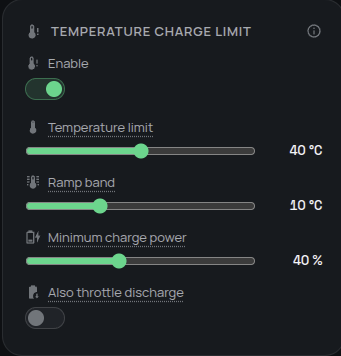
The default controls are:
| Control | Effect | Default |
|---|---|---|
| Temperature Charge Limit | Full power is allowed at or below this temperature; reduction begins above it | 40 °C |
| Temperature Charge Limit Band | Temperature span over which power falls toward the configured floor | 10 °C |
| Temperature Charge Limit Floor | Lowest percentage of the current power ceiling at the top of the band | 40% |
| Temperature Discharge Limit | Applies the same curve to discharge | Off |
What you will see
Below the configured limit, this feature does not change the battery's power ceiling. As the battery heats through the ramp band, the permitted power falls smoothly; as it cools, power rises smoothly again.
With the defaults, reduction starts above 40 °C and reaches the 40% floor at 50 °C. Other active battery limits can still produce a lower ceiling.
Integration Status includes temperature_charge_limit details for each battery: its reported temperature, configured limit, ramp band, floor, reduction factor, and whether derating is active.
If it does not work
| Symptom | Likely cause | What to check |
|---|---|---|
| Power does not reduce when a battery is hot | The feature is off, or the temperature has not crossed the configured limit | Temperature Charge Limit, Internal Temperature, and the configured threshold |
| One battery reduces power and another does not | Limits are calculated from each battery's own temperature | Both batteries' Internal Temperature values |
| A battery with no temperature reading keeps charging | Missing or invalid temperature data leaves its existing limit unchanged | Battery availability and the internal-temperature entity |
| Power does not fall as low as the percentage suggests | The driver declares a minimum reliable operating power | The battery's supported power range and Integration Status |
| Discharge remains unrestricted | Discharge limiting is optional | Temperature Discharge Limit |
Advanced details
The configured floor is a percentage of the current per-battery ceiling, after any earlier control limit. For temperature T, limit L, ramp band B, and floor fraction F, Omnibattery uses:
factor = 1                                      when T <= L
factor = 1 - ((T - L) / B) × (1 - F)           when L < T < L + B
factor = F                                      when T >= L + B
temperature_limited_power = current_limit × factor
The curve is continuous and has no separate cooldown latch or hysteresis. A missing or non-numeric temperature passes the existing limit through unchanged.
Omnibattery never raises a ceiling imposed elsewhere. After applying the percentage, it also respects any minimum reliable charge or discharge power declared by the battery driver. Drivers that declare no minimum can reach 0 W when the configured floor is 0%; a driver with a non-zero minimum remains at that declared operating floor.
Temperature Discharge Limit uses the same charge-tuned curve. It is disabled by default because discharge may tolerate heat differently; enable it when reducing both directions is appropriate for your installation.