Load exclusion
See Excluded devices for configuration.
How it works internally
When an excluded device is active, the controller subtracts its power from the grid consumption before computing the PD controller adjustment:
effective_consumption = grid_consumption - excluded_power
error = effective_consumption - target_grid_power
This causes the battery to "ignore" that load and not try to compensate it.
If the device is NOT included in the main sensor
The integration adds the excluded device's power to the measured grid consumption (because the main sensor does not see it) and then subtracts it, resulting in the same net effective consumption.
"Allow solar surplus" option
When active, if the system is operating on solar surplus (battery is charging from surplus), the exclusion does not apply to the charging side. In other words: the battery will not charge to compensate this device's consumption when solar surplus is already available.
This is the basis for EV vs. battery charging priority:
| Mode | Battery charges with solar? | Battery discharges for device? |
|---|---|---|
| Excluded, surplus OFF | Yes | No |
| Excluded, surplus ON | No — solar goes to device first | No |
Solar Surplus switch (runtime control)
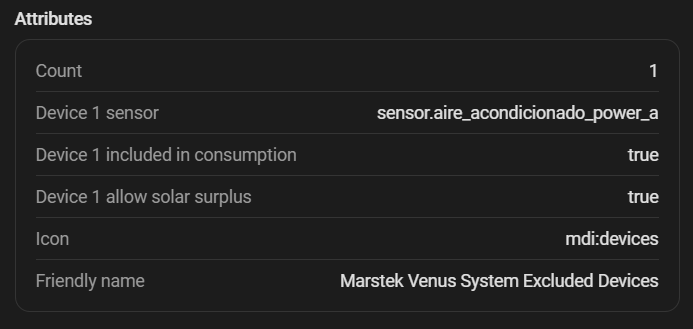
Each excluded device gets a dedicated Solar Surplus switch entity that toggles this behaviour at runtime without reconfiguring the integration. Use it in HA automations to change priority dynamically:
# Example: prioritise EV when connected
automation:
  trigger:
    - platform: state
      entity_id: binary_sensor.ev_connected
      to: "on"
  action:
    - service: switch.turn_on
      target:
        entity_id: switch.solar_surplus_wallbox_power
Dynamic Power Control switch
For a wallbox or another flexible load with its own surplus controller, standard Solar Surplus can still leave two controllers settled at an undesirable split: the battery removes export before the wallbox has a chance to ramp up. Dynamic Power Control adds a small state machine around the normal exclusion logic.
The device-active / EV-charging state sensor closes the cold-start gap: while it requests power but the wallbox still reads 0 W, battery charging stays blocked so the wallbox can see the export and start. It is required for new Dynamic Power Control configurations; existing sensor-less entries keep their measured-power fallback.
On first measured demand it blocks battery charging for 30 seconds. Charging may then resume only on the export the device left behind. A rise of at least 200 W in available margin (solar production minus device power) triggers a new 20-second yield; this also catches a wallbox reducing power while solar production is stable. A zero-power pause keeps discharge blocked for five minutes and gives charging a short restart grace so the device can restart. No maximum-demand sensor is needed.
EV charger without power telemetry
For EV chargers that only expose a state sensor (no real-time power reading), a dedicated EV charger without power telemetry option is available. The same device-active / EV-charging field is used. Legacy entries that stored this state sensor in the old device-sensor field continue to work unchanged.
| Phase | Battery behaviour |
|---|---|
| EV state → Charging (first 5 min) | 0 W — both charge and discharge blocked, PD state frozen |
| EV charging (after 5 min) | Charging from solar surplus allowed; discharge always blocked |
| EV state → anything else | Normal operation |
See EV charger without power telemetry in the configuration reference for setup details.