Predictive charging — Real-Time Price mode
Activates or deactivates grid charging every controller cycle (event-driven) based on the current electricity price.
Unlike Dynamic Pricing mode, it requires no price forecast and no overnight evaluation. It reacts purely to the live price.
Deadline-based slot selection is intentionally not applied in this mode: a current-price sensor provides no trustworthy future intervals to reserve before a deadline. The energy balance and per-battery target remain predictive, but selecting or promising a future slot would require switching to Dynamic Pricing. Configured charge-permission windows and all physical blockers still apply.
Configuration
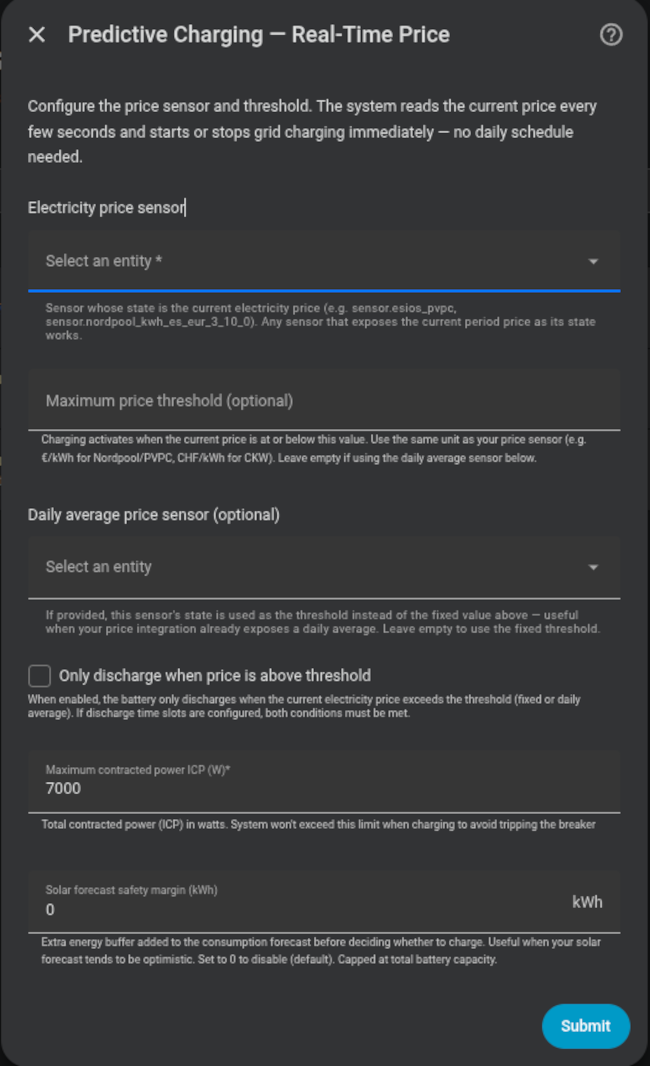
| Field | Description |
|---|---|
| Electricity price sensor | Any HA sensor with the current period price (PVPC, Nordpool, CKW…) |
| Maximum price threshold (€) | (Optional) Price below which grid charging activates |
| Daily average price sensor | (Optional) Dynamic threshold instead of a fixed value |
| Only discharge when price exceeds threshold | (Optional) Price-gated discharge — see below |
| Solar forecast safety margin (kWh) | Extra energy buffer added to the consumption forecast before deciding whether to charge (default 0 kWh) |
| Predictive grid charge margin (%) | Tops up the grid-charge amount to hedge optimistic solar forecasts — e.g. a 2 kWh grid need at 50 % charges 3 kWh. Capped at the gap to max SOC (default 0 %) |
Charging behaviour
Every cycle (event-driven) the controller evaluates whether to start or stop grid charging:
If current_price ≤ threshold:
    And if (battery + solar) < expected_consumption:
        → Activate grid charging
If current_price > threshold:
    → Deactivate grid charging
The energy balance (battery + solar vs. expected consumption) is evaluated before starting charging, the same as in other modes.
Threshold resolution
The threshold is resolved in this priority order:
- Daily average price sensor — if configured and available, its value is the dynamic threshold.
- Maximum price threshold — static numeric value configured in the setup flow.
If neither is available, the mode does not act.
Price-based discharge control
The "Only discharge when price exceeds threshold" option adds an extra condition to discharge behaviour, independent of charging.
When active, every controller cycle (event-driven) checks whether the current price justifies discharge using the same threshold as for charging:
If current_price > threshold:
    → Discharge allowed (PD controller operates normally)
If current_price ≤ threshold:
    → Discharge BLOCKED (battery holds)
The inverse logic of charging: charge when price is low, discharge when price is high.
Interaction with time slots
If time slots are configured to restrict discharge, both conditions must be met:
Effect on the PD controller
When discharge is blocked by price, the controller completely freezes its state (power to 0, no derivative term update), the same as during a time slot restriction. The battery resumes smoothly as soon as the price exceeds the threshold.
Differences from Dynamic Pricing
| Feature | Dynamic Pricing | Real-Time Price |
|---|---|---|
| Price forecast required | ✅ | ❌ |
| Overnight evaluation (00:05) | ✅ | ❌ |
| Reacts to live price | ❌ | ✅ |
| Optimal hour selection | ✅ | ❌ |
| Discharge threshold | Daily average (calculated at 00:05) | Configurable threshold (fixed or dynamic sensor) |
Real-Time Price remains reactive: it uses the normalized remaining total for its gate and does not consume the learned temporal curve or create future deadlines. A future anticipatory implementation should enter through the same chronological planner as the other scheduling modes.